
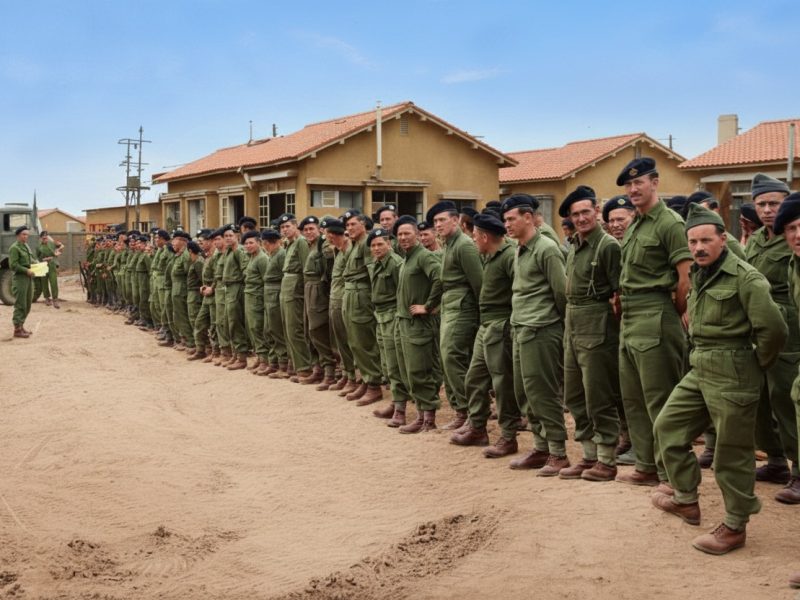
APRIL marks the 75th anniversary of one of the most celebrated – and costly – battles in the history of the Gloucestershire Regiment.
The last stand of the Glosters at the Battle of the Imjin River during the Korean War in 1951 helped save the city of Seoul from invasion by a huge force of Chinese soldiers – but came at a cost of 59 men killed in action and 522 taken prisoner, with a further 34 dying in captivity before the end of the war in 1953.
The Glosters were an Army infantry regiment headquartered at Horfield Barracks in Bristol, and drew many of their recruits from the city and surrounding area.
Sent to Korea as part of the United Nations force defending South Korea from the North and its Chinese allies, the 1st Battalion, Gloucestershire Regiment was part of the 29th Infantry Brigade, a force of around 4-5,000 guarding a ford over the Imjin River.
On the night of April 22 the 27,000-strong Chinese 63rd People’s Volunteer Army launched an attack, with the aim of sweeping aside the defenders and reaching Seoul by May Day.
Over the following three days, the 750 men of the 1st Battalion fought a defensive battle across a series of positions overlooking the river, against more than 10,000 Chinese regular troops, becoming increasingly isolated and eventually surrounded on Hill 235, which would become known as Gloster Hill after the battle.
While other units of the 29th Infantry Brigade managed to withdraw, attempts to relieve the Glosters and help them break out failed due to the overwhelming numbers of Chinese troops.
Describing the last stand, the National Army Museum says: “Towards the end of the battle the Glosters were completely surrounded and running out of ammunition.
“Some men were reduced to fighting with bayonets and fists. Against overwhelming odds they held the line against the Chinese for four days.
“When they were finally given the order to break out only 40 men managed to reach safety. The Chinese captured or killed the rest.
“The Gloucestershire Regiment’s actions in delaying the Chinese allowed the rest of the United Nations forces time to regroup and block the advance of the enemy towards the South Korean capital Seoul.”
Chinese casualties during their frontal assaults on UN positions were estimated at 10,000-15,000, and the 63rd Army was withdrawn from the front line after the battle.
The 1st Battalion’s actions earned the Gloucestershire Regiment the nickname the ‘Glorious Glosters’.
Commanding officer Lieutenant-Colonel James P. Carne, who was among those captured, was awarded a Victoria Cross, along with Lieutenant Philip Curtis, who was killed in a lone counter-attack on enemy machine-guns. Other Glosters received decorations including the George Cross, Distinguished Service Order, Military Cross and Military Medal.
The Gloucestershire Regiment and 170 Battery of the 45th Field Regiment, Royal Artillery were both awarded a US Presidential Unit Citation, the highest American award for heroism and collective gallantry.
Their citation said: “Without thought of defeat or surrender, this heroic force demonstrated superb battlefield courage and discipline.
“Every yard of ground they surrendered was covered with enemy dead until the last gallant soldier…was overpowered by the final surge of the enemy masses.”
The Gloucestershire Regiment became part of the Royal Gloucestershire, Berkshire and Wiltshire Regiment in 1994, then part of The Rifles in 2007.
The battle is being remembered by a series of special events at the Soldiers of Gloucestershire Museum in Gloucester Docks during April.
A weekend of talks takes place on April 18-19 – more details can be found online at soldiersofglos.com.
Chief executive Matthew Holden said: “Sadly, there are very few remaining survivors of the battle.” None are believed to live in the Bristol or South Gloucestershire area.
*Do you have a relative who fought at Imjin? Email news@downendvoice.co.uk.