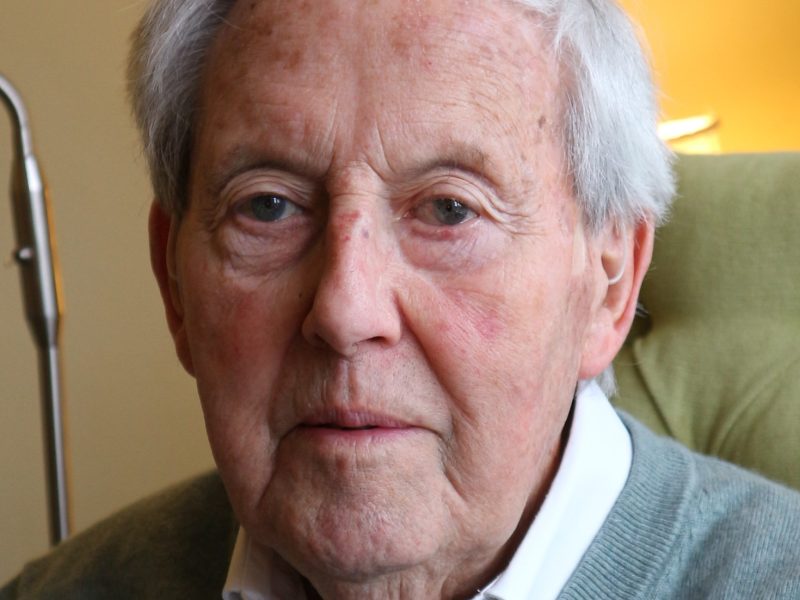
RETIRED surgeon Harold Griffiths, of Rudgeway near Thornbury, treated Glosters taken prisoner at Imjin after their release at the end of the conflict.
Harold was an officer in the Royal Army Medical Corps, based at the British Commonwealth General Hospital in Kure in Japan from 1952 until the end of the conflict in 1953, after which he was sent to take charge of a casualty collection post in Korea itself, as a company commander for the 26th Field Ambulance.
Born and bred in Monmouthshire, Harold was sent to Japan and Korea during his National Service after finishing his medical training in London.
The hospital in Japan received convoys of wounded twice a week from Korea. The wounded would be treated first at a US or Norwegian MASH (Mobile Army Surgical Hospital) in Korea before being transported to Seoul and shipped to Japan.
Harold remembers treating soldiers injured in battles during the later stages of the war, including from the Duke of Wellington’s Regiment during the Battle of the Hook in 1952.
He said: “The only time I got to see the Glosters was when there was a prisoner swap, and they came through and had to be examined before they could be given a clean bill of health to travel on the ship home.
“A lot had got parasitic infections in captivity, and several had got anaemia, dysentery and tapeworm, and were very thin.
“Lt Col Carne, the CO, was given a uniform but he was so thin it sort of hung off him – he was treated particularly badly in captivity.
“The thing that struck me was that most of these people were National Servicemen, all these soldiers who behaved as seasoned warriors.
“We felt very sorry for them – they were shipped into National Service and ended up with some very serious injuries.
“Most of them were very stoical.”
After being posted to a base near Imjin after the war finished, Harold was able to see the battlefield and took pictures of abandoned positions.
He said: “We were situated just north of where the Glosters made their last stand and within a mile of the Imjin river.
“You had to be careful where you walked – there was a certain amount of ordnance still lying in the grass.”
After the conflict ended, medical staff were still kept busy treating soldiers for a variety of illnesses and injuries.
They included haemorrhagic fever, a severe and often fatal virus. Anyone suspected of having the disease was evacuated by US helicopters, which would later become familiar to millions of TV viewers through the American Korean War drama MASH, because they would not survive long enough to be taken to hospital by land and sea.
After the end of his service Harold returned to the UK and became an orthopaedic surgeon in London and Glasgow before moving to Bristol, where he was based at Southmead and Frenchay hospitals until he retired.
He was on the Army’s reserve list for two years and transferred to the Territorial Army, commanding the field hospital in Keynsham for several years.