
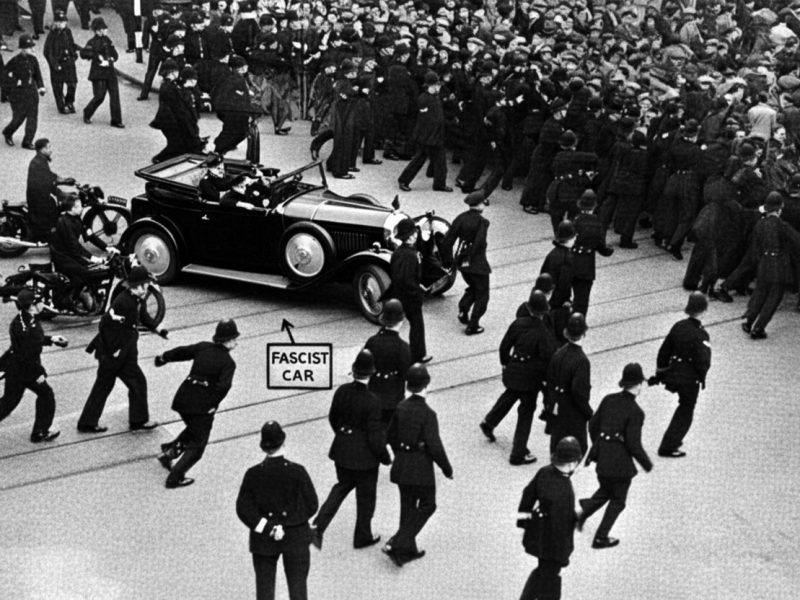
RECENTLY I was in London, marching through the streets to remember the day, exactly 90 years earlier, when thousands said “they shall not pass” to Oswald Moseley’s blackshirts.
To be precise, they said “No Pasaran”, the Spanish Republican cry associated with the battle against fascism.
Among those hearing the words for the first time, at what became known as the Battle of Cable Street, was a man who now lies in a grave at a small church in Portbury, near Bristol.
Up to 350,000 people turned out to stop Moseley’s British Union of Fascists marching through the heart of the East End’s working class Jewish community, and fought with the 7,000 police ordered to escort the blackshirts.
One of them was Johnny Longstaff.
In 1934, aged just 15, Johnny joined a hunger march from Stockton on Tees in the North East to London, organised to highlight the plight of unemployed workers like him.
In London Johnny learnt about the rise of fascism first-hand, meeting Jewish refugees from Germany.
The experience of fighting to stop Britain’s home-grown Nazis at Cable Street in October 1936 radicalised Johnny.
He signed up to fight in Spain, where a military coup, backed by Nazi Germany and fascist Italy, led to civil war. Volunteers from across the world risked all to fight for democracy in the International Brigades.
After many battles, Johnny’s story in Spain ended defending Hill 666 near Gandesa, Catalonia. Under heavy artillery bombardment, he was severely wounded and temporarily blinded.
Soon after returning to the UK, Johnny volunteered to fight fascism again in the Second World War.
Initially rejected because he had fought in Spain, he was eventually recruited and fought again, this time in North Africa and Italy, including the key battles of El Alamein and Monte Cassino. He was promoted to sergeant and decorated for bravery.
I came across Johnny’s story during an event at Bristol Beacon about the International Brigades, where I was introduced to his son Duncan, who lives locally.
Duncan told me the extraordinary story of his father’s heroism, which he had originally recorded for the Imperial War Museum.
He gave his father’s testimony to The Young’uns, a folk group I’ve hosted at a workshop for Downend School students. They’ve also played at Downend Folk & Roots.
The Young’uns produced a critically acclaimed musical and stage performance on Johnny’s life, performed in a church off Cable Street the eve of the 90th anniversary of the ‘battle’.
Johnny moved to the West Country with his wife when Duncan took up his care. He died here in 2000, which is why St Mary’s churchyard includes a grave emblazoned with the credentials of a soldier of the International Brigades, who risked all for his principles and joined so many important battles against tyranny and human misery.
To find out more, visit theyounguns.co.uk/johnnylongstaff.
Nick Smith