THE Prince of Wales has found out how Bristol’s universities are working together to use robotic technology to help older and disabled people.
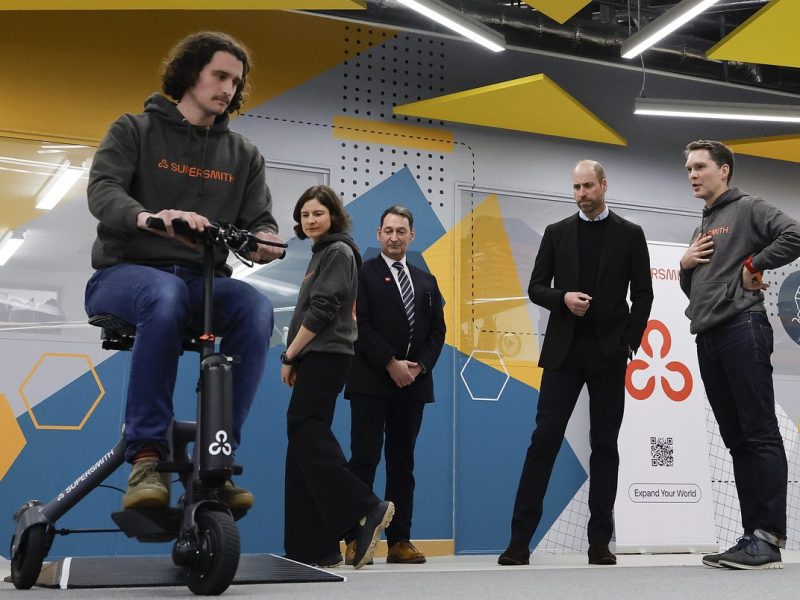
The prince visited the Bristol Robotics Laboratory at the University of the West of England’s Frenchay campus in January to meet researchers and start-up businesses working in areas including smart garments, exoskeletons and self-stabilising mobility scooters.
BRL is a joint venture between UWE and Bristol University, and is described by the two universities as “the most comprehensive academic centre for multi-disciplinary robotics research in the UK”.
Prince William met the engineering research team at the VIVO Hub for Enhanced Independent Living, where robotic and digital healthcare technology is being combined to develop new equipment to help older and disabled people, including clothing that can help prevent falls, and support people getting up from a chair, climbing stairs and walking.
The prince also met the founders of two start-up firms led by Bristol University graduates: Supersmith, which is building mobility scooters with self-stabilising robotic technology, and Milbotix, which is making ‘wearable technology’, including socks that monitor dementia patients’ well-being.
UWE Bristol’s pro-vice chancellor for research and knowledge exchange, Professor Darren Reynolds, said: “Prince William has seen first-hand our thriving community of tech-minded and solutions-focused entrepreneurs and researchers, reimagining tomorrow through robotics and the power of AI.
“These start-ups are addressing societal challenges that will improve people’s lives and power our economy.”
Earlier the same day the prince was at the Bristol and Bath Science Park in Emersons Green, where he visited the National Composites Centre and Isambard-AI supercomputer.
The £225m government-funded national facility, built and run by the Bristol Centre for Supercomputing (BriCS), was officially launched in July last year and is the world’s fastest university supercomputer.
Prince William met BriCS director Professor Simon McIntosh-Smith, as well as Bristol University senior research fellow Dr Danielle Paul, whose British Heart Foundation-funded research is using the supercomputer in the development of new drugs to combat heart disease, and climate scientist Professor Dann Mitchell, whose research shows how to use AI to better predict extreme weather under different climate scenarios.
Bristol University deputy vice-chancellor Professor Judith Squires said: “Today’s visit shines a light on the extraordinary impact that is possible when universities, industry and regional partners work together with a shared sense of purpose.”