The weaver’s waltz – a workers’ champion in Bristol
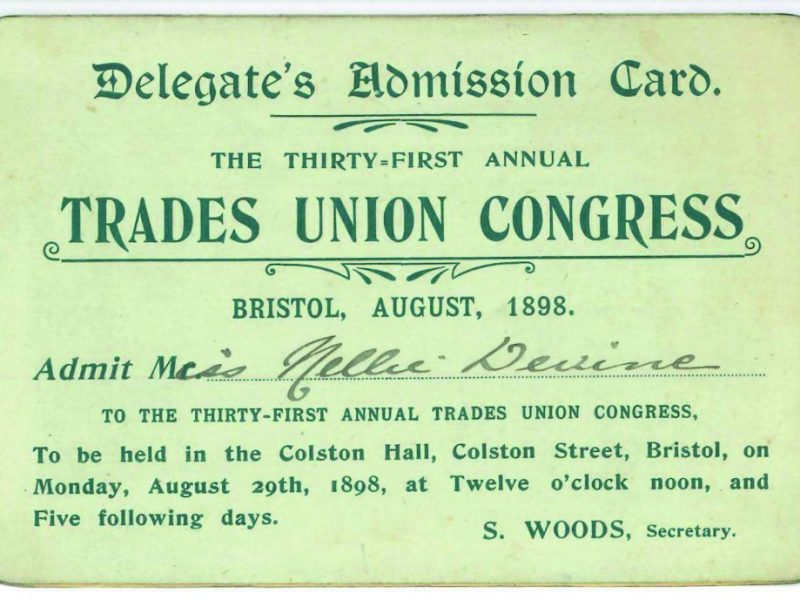
IT began with a collection of trade union materials from the 1898 Trades Union Congress that I bought.
These documents, including a silk rosette and a dance card filled with names, had once belonged to a woman named Miss Nellie Devine, an ‘Oldham Weaver’.
The story I discovered gave an insight into the Victorian labour movement and the hidden role of women in the fight for workers’ rights.
The 1898 TUC conference in Bristol was destined for drama before it even began.
Scheduled to be held at the Colston Hall (now the Bristol Beacon), the proceedings were interrupted by a catastrophic fire at the neighbouring Clark’s clothing factory.
The theatre was largely destroyed, forcing delegates to make emergency arrangements.
Despite the chaos, Nellie’s collection paints a picture of a vibrant, high-society welcome for these labour pioneers.
It includes a lunch invitation from Lady Dilke, a famed suffragist and trade unionist, at the Royal Hotel, College Green, and programmes for tea dances at Hannah Moore Hall, receptions at the Academy of Fine Arts, and performances by The Bristol Glee Men.
There was also a visit to Goldney House, hosted by radical Quaker and Bristol Liberal politician Lewis Fry.
Born Mary Ellen Devine in 1864 to Irish immigrants, Nellie lived her early years in a single room above a Salford pub. By the 1881 census, following her father’s death, she was one of six family members (plus two lodgers) crammed into a home in the industrial area of Ellor Street.
She became a weaver, in an industry notorious for dreadful working conditions and an area that inspired Friedrich Engels to write his book The Condition of the Working Class in England, and influenced the creation of the Communist Manifesto with Karl Marx.
Nellie refused to be a silent statistic, rising through the ranks of the Oldham & District Weavers and Winders Association.
In an era when women didn’t even have the vote, she appears in parliamentary records as a campaigner in an inquiry into the brutal conditions of weaving sheds.
Oldham in the 1890s was a crucible for change, a key site in the founding of the Independent Labour Party.
For Nellie, the union was a conduit for class-breaking social mobility and political agency.
By the 1921 census, she had moved to the leafy suburbs of Manchester and was a civil servant in the Ministry of Labour.
When she died in 1956, aged 92, Nellie had lived to see the birth of the Welfare State. She had fought in the battles that led to workers’ rights…and in 1898, she had danced the night away in Bristol.
What a woman, what a life.
For more information about Downend Community History and Arts Project (CHAP) visit www.downendchap.org.
Nick Smith