
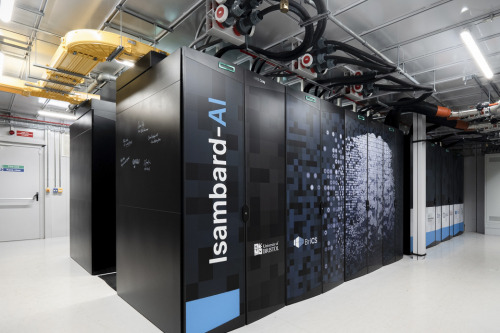
THE UK’s most powerful artificial intelligence supercomputer has celebrated its first year of operation.
Since being switched on last summer at the Bristol & Bath Science Park in Emersons Green, Isambard-AI has helped researchers tackle some major challenges, including:
*Improving understanding of Alzheimer’s disease using AI trained on NHS data
*Building large language models – AI systems trained on huge amounts of text – to support languages including Welsh, Scottish Gaelic and Cornish
*Creating air pollution models to improve public health
*Accelerating research into heart disease and cancer
The computer cost £225 million to develop and build, but can work at speeds 100,000 times faster than the average laptop, according to Bristol University, which runs the Bristol Centre for Supercomputing (BriCS).
In its first year, Isambard-AI has supported around 1,000 research projects involving more than 4,000 people.
BriCS director Professor Simon McIntosh-Smith said: “One year ago, we switched on a national capability that gives UK researchers the computing power to tackle problems at a completely different scale. In 12 months we’ve seen extraordinary demand and, more importantly, extraordinary impact. From healthcare and climate science to farming and AI safety, researchers are using Isambard-AI to make discoveries that simply weren’t possible before.
“This is what investing in sovereign AI infrastructure looks like: world-class research, economic opportunity and real benefits for society.”
Among the Bristol University projects benefiting from Isambard-AI is research led by Professor Andrew Dowsey at Bristol Veterinary School, which is using video data to improve the health and welfare of dairy cattle, training AI models to recognise small behavioural changes that can indicate illness long before the symptoms become obvious to people.
Prof Dowsey said: “No farmer can watch every animal every minute of every day, but AI can. “Isambard-AI gives us the computing power to spot the earliest signs of disease before they’re visible to the human eye, helping us intervene sooner, improve animal welfare and reduce the impact of disease on farms.
“Our ambition is to turn this research into an affordable tool that supports farmers across the UK while helping build a healthier, more sustainable future for livestock farming.”
Isambard-AI is the world’s fastest university supercomputer. Ranked 13th most powerful in the world, including commercial supercomputers, it is the seventh most powerful in Europe and fourth greenest globally, on the basis of its use of renewable electricity and its energy efficiency.
BriCS is now planning its next phase, including the Bristol AI Data Facility (BRAID), a massive data storage unit next to Isambard-AI which the university says will “unlock the supercomputer’s full potential”.